Domestic Intelligence: The Algorithmic Blueprints Concealed Inside Your Smart Home Ecosystem
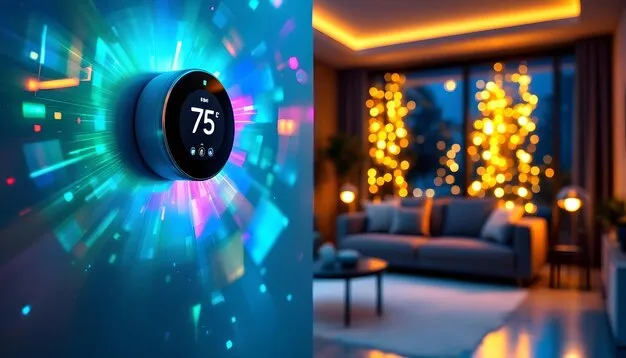
Photo: smart thermostat glowing display home interior night, via img.freepik.com
There is a particular comfort in arriving home to a space already set to your preferred temperature. The hallway is warm in winter before you remove your coat. The bedroom cools precisely when you typically retire. These small conveniences feel intuitive — almost considerate. What they actually represent is something considerably more calculated: the output of a behavioral inference engine that has been silently decoding your life for months.
The modern smart home device is, at its core, a data acquisition instrument disguised as a convenience appliance. Understanding the full scope of what these devices encode — and for whom — requires examining the computational layers that most manufacturers have no incentive to explain clearly.
The Thermostat as a Listening Post
Consider the architecture of a contemporary smart thermostat. On its surface, the device performs a straightforward task: it reads ambient temperature and activates heating or cooling systems accordingly. This functional description, however, accounts for perhaps ten percent of what the device actually does.
Beneath the interface, the thermostat operates as a continuous sensor array. Occupancy detection — typically achieved through passive infrared sensors or radar-based presence detection in newer models — generates a timestamped record of when rooms are occupied, for how long, and by how many individuals. Motion data is cross-referenced against time-of-day to establish what engineers call a "presence signature," a compressed behavioral fingerprint that encodes the rhythms of your household.
Temperature preference data adds another dimension. The adjustments you make manually — nudging the dial up by two degrees on Sunday mornings, dropping the temperature an hour before bed — are not simply stored as preferences. They are processed through regression models that identify correlations between your behavioral inputs and external variables: outdoor temperature, day of week, weather forecasts, and in some systems, calendar integrations that flag upcoming schedule deviations.
The result is not a record of what you did. It is a probabilistic model of what you are likely to do next.
Nested Data Layers and the Compression of Intimacy
What makes smart home behavioral profiling particularly sophisticated — and particularly opaque — is the layered nature of the data architecture. Raw sensor readings are rarely transmitted or stored in their original form. Instead, they pass through a series of compression and abstraction processes that convert granular observations into higher-order behavioral categories.
Sleep pattern detection offers a useful illustration. A thermostat does not explicitly know when you are asleep. It does, however, register that occupancy in the bedroom is detected after 10:47 PM on most weeknights, that temperature adjustment requests cease at approximately that time, and that the first manual interaction with the device occurs between 6:15 and 6:45 AM. From these inputs, a sleep window is inferred — not with certainty, but with a statistical confidence that improves over time.
This inferred data point is then encoded into the device's predictive model alongside dozens of similar abstractions: meal preparation windows derived from kitchen occupancy patterns, work-from-home indicators derived from midday presence signatures, and social gathering inferences drawn from anomalous occupancy events that deviate from baseline household rhythms.
Each layer of abstraction moves the data further from its raw form and closer to a behavioral taxonomy that has genuine commercial value. By the time this information reaches a manufacturer's cloud infrastructure, it no longer resembles temperature readings. It resembles a lifestyle profile.
Who Receives the Blueprint
The question of data destination is where the cipher becomes genuinely consequential. Smart home device manufacturers operating in the United States are subject to privacy policies that, in most cases, permit the sharing of aggregated or anonymized behavioral data with third-party partners for purposes including product improvement, targeted advertising, and market research.
The term "anonymized" deserves scrutiny here. Behavioral data derived from a specific household — particularly when it includes occupancy patterns, sleep windows, and daily routine signatures — carries a degree of specificity that resists true anonymization. Research in the field of re-identification has consistently demonstrated that behavioral datasets with sufficient temporal resolution can be linked back to individuals even after direct identifiers are removed.
Insurance companies have expressed documented interest in smart home behavioral data as a proxy for lifestyle risk assessment. Utility companies in several US states have entered into data-sharing arrangements with smart device manufacturers that grant access to consumption and occupancy patterns. Advertising platforms incorporate smart home behavioral signals into audience segmentation models that influence the commercial content you encounter across entirely separate digital environments.
Your thermostat, in other words, is not merely in conversation with your HVAC system. It is contributing to a distributed intelligence network that extends well beyond the walls of your home.
The Architecture of Anticipation
Perhaps the most revealing aspect of smart home behavioral encoding is the explicit design goal that manufacturers themselves articulate: anticipation. The stated purpose of machine learning integration in these devices is not to respond to your preferences but to predict and preempt them.
This distinction matters. A device that responds to your input operates as a tool. A device that anticipates your behavior operates as an inference engine — one that, by definition, must maintain and continuously refine a model of who you are and how you live.
The commercial framing of this capability emphasizes convenience. The less-discussed implication is that the anticipatory function requires the device to maintain a behavioral model of sufficient resolution to generate accurate predictions. Accuracy, in this context, is not achieved through broad generalizations. It is achieved through granular, longitudinal observation of the specific individual whose behavior is being modeled.
The cipher embedded in your thermostat is not written in a language designed for your comprehension. It is written for the systems and institutions that have learned to read it fluently — and who find, in the intimate patterns of your daily routine, a text worth studying carefully.
Decoding Your Own Exposure
For those inclined to audit their own smart home data footprint, several practical entry points exist. Most major smart home platforms — including those operating under the Google, Amazon, and Ecobee ecosystems — offer data access portals through which users can request exports of stored behavioral data. Reviewing these exports, even in their processed form, provides a useful illustration of the inferential depth these systems achieve.
Network-level monitoring tools, such as Pi-hole or dedicated home network analyzers, can reveal the frequency and destination of data transmissions originating from smart devices — a practice that often produces surprising results regarding the volume of outbound communication generated by ostensibly passive appliances.
The grid of your domestic life is more legible to external parties than the ambient warmth of your home might suggest. Decoding that legibility is, as with most things worth understanding, a matter of knowing where to look.