Silent Cartographers: How Mobile Apps Map Your Behavior Without Your Knowledge
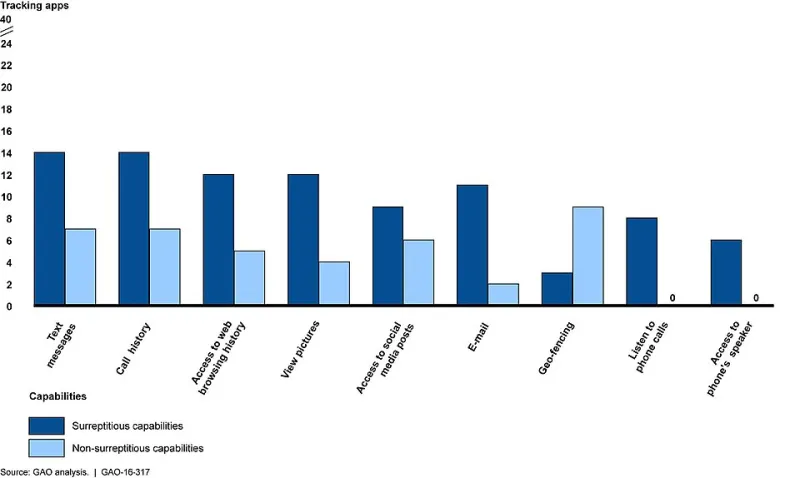
Photo: U.S. Government Accountability Office from Washington, DC, United States, Public domain, via Wikimedia Commons
The smartphone in your pocket is, among other things, a precision instrument for behavioral cartography. Every tap, hesitation, scroll velocity, and session duration is a data point — and the applications you use most casually are often the most sophisticated collectors of that information. The mechanisms through which this collection occurs are rarely disclosed in terms of service agreements written to be skimmed rather than read. They are, by design, encrypted into the operational substrate of the app itself.
At Cipher Grid, we concern ourselves with the signals others overlook. This is one of the most consequential.
The Architecture of Concealment
When a developer submits an application to the Apple App Store or Google Play, the submitted binary contains far more functional logic than the user ever directly encounters. Embedded within that binary are Software Development Kits — SDKs — sourced from third-party analytics and advertising firms. Names like Amplitude, Mixpanel, Adjust, AppsFlyer, and Branch appear in the dependency trees of thousands of popular consumer applications, from retail platforms to fitness trackers to news readers.
These SDKs function as silent sub-tenants within the application. They operate under the host app's declared permissions, meaning that when a user grants a weather application access to location data, that permission may simultaneously authorize a third-party analytics SDK to log geolocation events at intervals the user never agreed to — and in many cases, never knew were technically possible.
The data these systems collect is rarely transmitted in plaintext. Instead, it moves through encrypted HTTPS channels to remote endpoints, where it is aggregated, timestamped, and cross-referenced against identifiers such as the Identifier for Advertisers (IDFA) on iOS or the Google Advertising ID (GAID) on Android. These identifiers function as persistent pseudonymous labels that allow behavioral data to be stitched across applications and sessions into a coherent longitudinal profile.
Obfuscation as Standard Practice
Code obfuscation — the deliberate restructuring of source code to make it difficult to interpret during reverse engineering — is a standard feature of commercial mobile development. Tools such as ProGuard and R8 for Android, and various Swift obfuscation libraries for iOS, rename variables, flatten control flows, and strip readable identifiers from compiled code. The stated rationale is intellectual property protection. The practical consequence is that the behavioral tracking logic embedded within an app becomes substantially harder for independent security researchers, journalists, and regulators to audit.
This is not incidental. The friction introduced by obfuscation creates a temporal moat: by the time a researcher fully decodes the tracking architecture of a given application, the app has likely updated, altering the code structure and restarting the audit process. The system is self-renewing in its opacity.
Beyond obfuscation, some applications employ a technique known as dynamic code loading — downloading executable logic from remote servers at runtime rather than bundling it within the app at installation. This means that the application a user installs may behave differently from the application reviewed during the platform's security screening process. The tracking payload, in effect, arrives after the gatekeeper has looked away.
Telemetry Signals Worth Recognizing
For users in the United States who wish to develop a more calibrated understanding of what their applications are doing, several technical markers are worth learning to identify.
Network traffic analysis is among the most accessible. Tools such as Charles Proxy or the open-source mitmproxy allow a technically inclined user to route their device's traffic through an intercepting proxy, revealing the endpoints to which an application is transmitting data. An application sending frequent, encrypted POST requests to domains associated with analytics vendors — particularly during idle periods or immediately after specific user interactions — is exhibiting the behavioral signature of active telemetry.
Permission auditing is a simpler, if less precise, starting point. Both iOS and Android provide system-level interfaces through which users can review the permissions granted to each installed application. An application that requests access to contacts, microphone, precise location, or clipboard without a transparent functional justification for each represents an elevated risk profile. The California Consumer Privacy Act (CCPA) nominally provides US residents the right to know what personal data is collected and to opt out of its sale, but enforcement remains inconsistent and the practical burden of exercising those rights falls almost entirely on the individual.
App permission behavior during onboarding is a behavioral tell in itself. Applications that present permission requests before delivering any core value — requesting location access on the first screen, for instance, rather than at the contextually logical moment when location functionality is actually needed — are frequently optimized to capture permissions before user skepticism fully activates.
The Profile You Did Not Consent to Build
The cumulative product of this distributed, multi-application telemetry architecture is a behavioral profile of considerable resolution. Session frequency and duration reveal daily routines. Scroll behavior within content feeds signals political and commercial affinities. Purchase event logging across retail applications constructs a detailed financial profile. Location history, even when collected at low frequency, can identify home address, workplace, religious attendance, and medical facility visits with high confidence.
This profile does not belong to the user. It is owned, licensed, and sold by entities the user has typically never interacted with directly. Data brokers such as Acxiom, LiveRamp, and Oracle Data Cloud aggregate inputs from hundreds of SDK-equipped applications into unified identity graphs that are subsequently licensed to advertisers, insurers, employers, and political campaigns.
The cipher is not particularly subtle once you know where to look. The applications most deeply integrated into American daily life — the ones used for navigation, social connection, news consumption, and financial management — are simultaneously the most active participants in this surveillance economy. The user interface is the visible signal. The telemetry architecture is the message encoded beneath it.
Decoding Your Own Exposure
The appropriate response to this landscape is not paralysis but informed navigation. For users willing to invest modest technical effort, a VPN combined with a DNS-level ad and tracker blocker — services such as NextDNS or AdGuard's DNS service — can substantially reduce the volume of telemetry that successfully reaches its destination. Regularly rotating the advertising identifier on both iOS and Android degrades the longitudinal coherence of behavioral profiles. Conducting periodic permission audits and removing access that cannot be justified by a specific, observable application function reduces the surface area available for collection.
None of these measures are complete solutions. They are, however, the beginning of a more literate relationship with the devices and applications that have become, for most Americans, indistinguishable from daily life itself.
The grid is not neutral. It is being read, continuously, by systems designed to ensure you never notice the reading is occurring.